


Building a B2B SaaS solution for the DACH market means facing a double challenge from the first commit: the software has to work, and it has to be scalable, secure, and planned with compliance in mind. Mistakes in architecture or data protection cost a multiple of what careful upfront planning would have. Seed- and Series-A-funded startups in particular underestimate how hard regulatory requirements and technical debt can throttle growth — usually right when they're trying to close their first enterprise deal. This guide lays out the requirements, architecture decisions, and validation steps that actually matter, and the specific failures we keep seeing on funded teams.
Table of contents
- Requirements and prerequisites for production-ready SaaS in the DACH market
- Technical foundations: architecture and multi-tenant security
- Checklists and best practices for production readiness
- Validation, rollout, and ongoing scaling
- From real projects: what breaks before launch (and after)
- Further support for production-ready SaaS
- Frequently asked questions
Key takeaways
| Point | Details |
|---|---|
| GDPR compliance as a baseline | Plan for data-protection requirements from launch — retrofitting them is what gets expensive in the DACH market. |
| Scalable architecture prevents expensive mistakes | Multi-tenant isolation and security put in place early minimise the risk of data leaks and performance issues. |
| Checklists and tests support operational readiness | Systematic validations, test coverage on critical paths, and monitoring are non-negotiable before launch. |
| Operational excellence as a competitive advantage | A holistic approach that includes CI/CD and compliance processes drives sustainable growth. |
Requirements and prerequisites for production-ready SaaS in the DACH market
After framing the problem, we focus on the specific requirements of the DACH market so the foundation is laid correctly. Skipping this step risks fines and lost deals, because enterprise customers won't get the proof points they need.
GDPR compliance as a structural obligation
GDPR is not a theoretical requirement in the DACH market — it's an operational reality with measurable consequences. Violations can attract fines of up to €20 million or four percent of global annual turnover, whichever is higher (the upper of the regulation's two penalty tiers). The decisive point: data protection cannot be retrofitted; it has to be anchored in the architecture from the start. Privacy by Design and Privacy by Default (Art. 25 GDPR) are not marketing terms — they are technical design principles with concrete implications for database models, logging systems, and API designs.
For B2B SaaS this means concretely: every processing of personal data needs a legal basis, every transfer outside the EEA needs a documented lawful mechanism (an adequacy decision, Standard Contractual Clauses, or Binding Corporate Rules — plus a Transfer Impact Assessment where adequacy is absent), and data-subject rights such as access or deletion must be technically implementable, not just promised in a policy. A Data Processing Agreement (DPA) in German is non-negotiable for many DACH buying centres.
Local hosting and buying-centre complexity
Cloud-hosting preferences in the DACH market are clear: enterprise customers prefer servers in Germany or the EU, and many categorically rule out US-only hosting — not because GDPR forbids US hosting outright, but because every third-country transfer adds documentation, risk, and procurement friction. The technical SaaS requirements extend well beyond server location. Sub-processors, CDN providers, and monitoring tools also need to be reviewed against GDPR requirements.
Add to this the complexity of buying centres: DACH-specific requirements include strict GDPR enforcement, local hosting preferences, and multi-step decision processes that involve IT, the data-protection officer, and the works council. A deal can stall at any of these stakeholders if the documentation is incomplete.
Certifications as a competitive factor
| Certification | Relevance | Typical effort |
|---|---|---|
| ISO 27001 | Very high for enterprise | 6 to 12 months |
| SOC 2 Type II | High for US-leaning customers | 3 to 9 months |
| BSI C5 | Relevant for German public sector | 6 to 18 months |
| TISAX | De facto required by automotive OEMs (contractual, not statutory) | 6 to 12 months |
The most important prerequisites at a glance:
- DPA in German, with a clear description of the processing activities
- Record of processing activities (RoPA), maintained technically and kept current
- Data Protection Impact Assessment (DPIA) for high-risk processing
- Incident-response plan with the statutory 72-hour authority notification window built in (Art. 33)
- Sub-processors list with current contracts and location details
Pro tip: when planning a scalable software architecture, put data-protection requirements into the backlog as technical user stories — "as a tenant admin I can export and erase all my data" — not as documentation tasks pushed to the end.
Technical foundations: architecture and multi-tenant security
With requirements established, the focus shifts to concrete technical implementation for security and scaling. The architecture decisions made in this phase determine whether the system is still maintainable in 18 months — or whether a rewrite becomes inevitable.
Multi-tenant architecture as a foundation
Multi-tenant SaaS means several customers (tenants) share the same infrastructure and codebase but remain fully isolated. There are three foundational models: shared database with row-level security, separate schemas per tenant, and fully separate database instances. Each model has different cost, scalability, and security implications.
The shared-database model with row-level security (RLS) is the most pragmatic entry point for most seed-stage startups. It significantly reduces operating costs but requires disciplined engineering to prevent leaks between tenants. PostgreSQL provides native RLS support that enforces, at the database layer, that every query returns only the current tenant's data — but RLS is a backstop, not the whole story (see below).

Critical security risks and mitigations
Well-known multi-tenant SaaS edge cases include the Noisy Neighbor problem, where one tenant consumes a disproportionate amount of resources, and Cross-Tenant Data Leaks caused by missing or buggy RLS implementations. Mitigation is defence in depth: never rely on a single layer, because one application-layer bug can collapse the isolation that RLS was supposed to guarantee. Concretely, that means per-tenant quotas with defined SLOs and application-layer authorisation checks that complement database-layer RLS.
| Risk | Cause | Mitigation |
|---|---|---|
| Cross-tenant leak | Missing RLS or bypass | RLS plus app-layer checks |
| Noisy neighbor | No resource limits | Per-tenant quotas and SLOs |
| Data loss on migration | Untested migration scripts | Staging with realistic tenant mix |
| Authentication failure | Misconfigured JWT | Validate tenant ID inside token |
Practical architecture thinking for production-ready systems follows a clear principle: security controls have to apply on multiple layers. Relying solely on RLS overlooks the fact that a single programming bug at the application layer can collapse the entire isolation.
One detail that trips teams up: when a tenant requests a resource it doesn't own, return 404 Not Found, not 403 Forbidden. A 403 confirms the resource exists and invites ID enumeration; 404 hides it, and the HTTP specification explicitly permits this "resource hiding" for forbidden resources. (401 Unauthorized is the wrong code entirely here — the caller is authenticated, just not authorised. Reserve 401 for missing or invalid credentials.)
Staging environments and migration tests
Migration tests in multi-tenant systems are particularly critical because one bug can hit every tenant simultaneously. A staging environment running only on synthetic data often fails to surface real problems. The recommended setup is a staging environment with a realistic mix of small, mid-sized, and large tenants, so that resource distribution and data isolation can be tested under realistic conditions.
"The most common production issues don't come from missing code — they come from missing tests under realistic conditions. A tenant mix in staging is not an optimisation; it's a baseline requirement."
Engineering for SaaS therefore typically includes setting up staging pipelines that can be auto-populated with anonymised production data so realistic test scenarios are reproducible.
Checklists and best practices for production readiness
With the architecture in place, the next goal is securing production readiness through systematic best practices and checklists. Production-ready SaaS is far more than working code: it includes operational processes, security documentation, and demonstrable quality assurance.
The production-readiness checklist
Production readiness means more than working code — it requires complete operational coverage with CI/CD, monitoring, security documentation, and test coverage above 80 percent. Boilerplate code typically does not cover these requirements, and a control plane for the tenant lifecycle is almost always missing.
The numbered checklist below covers the most important gates:
- Test coverage: around 80 percent as a common floor, with the critical paths (tenant isolation, authentication, billing) fully covered including edge cases. Coverage percentage is a proxy, not the goal — an untested isolation path at 90 percent overall coverage is still a breach waiting to happen.
- CI/CD pipeline: fully automated build, test, and deploy. No manual step in the deployment process.
- Observability: per-tenant metrics in monitoring dashboards. Alerts for anomalies in resource consumption and error rates.
- Backup and restore: backups tested daily, restore procedure documented and exercised at least monthly.
- Rollback procedure: defined process for rolling back to the previous version, tested in staging.
- Staging environment: production-near environment with a realistic tenant mix that runs before every release.
- Secrets management: no secrets in code, no secrets in environment variables without encryption. Use Vault or equivalent.
- Security documentation: threat model, penetration-test results, and remediation plan documented.
- Incident-response plan: clear escalation paths, communication templates, and the 72-hour GDPR notification window built into the runbook.
- Tenant lifecycle management: control plane for onboarding, offboarding, and on-demand data deletion.
Pro tip: the SaaS best-practices blog has concrete implementation examples for secrets management with HashiCorp Vault and Spring Boot.
"Production readiness is not a state you reach once and tick off. It is a continuous process that requires regular review and adjustment."
Project planning for SaaS should treat these checklist items as fixed milestones in the roadmap, not as optional tasks for after launch. In our experience, the effort to retrofit these items roughly doubles compared with planning them up front.
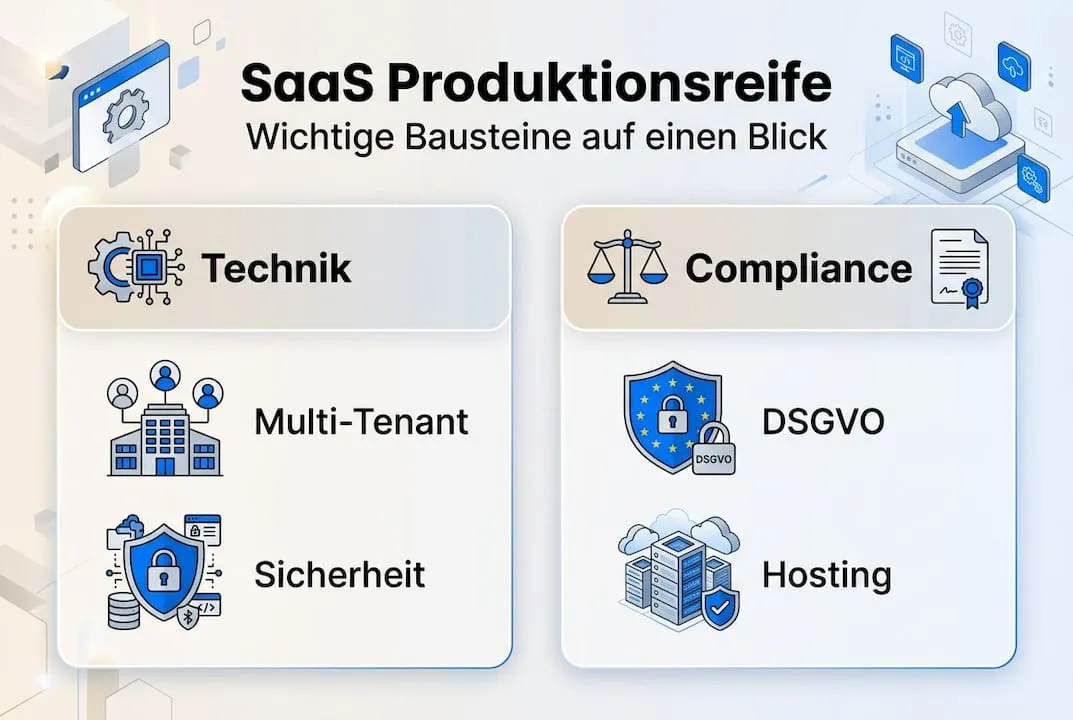
Secrets management as a critical point
Secrets in code or in unencrypted environment variables are one of the most common causes of security incidents in early-stage startups. Git repositories get accidentally made public, CI/CD logs leak credentials, and developer machines with local .env files get compromised. A central secrets-management solution like HashiCorp Vault, AWS Secrets Manager, or Azure Key Vault eliminates these risks structurally.
Validation, rollout, and ongoing scaling
Validation is complete. Focus now shifts to launch and long-term scaling. A structured go-live process prevents critical validation steps from being skipped under launch pressure.
Validation steps before go-live
- Monitoring validation: all critical metrics are visible in dashboards. Alerts are configured and tested. No blind spots in observability.
- Backup test: a full restore from the most recent backup has been performed successfully. The restore time is documented and within the defined RTO (Recovery Time Objective).
- Rollback drill: the rollback process has been rehearsed in staging. The team knows who does what, and in what order.
- Security review: the most recent penetration test is no older than three months. All critical findings have been remediated.
- GDPR checklist: DPA with all sub-processors is current. Privacy notice is current and technically accurate. Data-subject rights are technically implemented and tested.
- Load test: the system has been tested under simulated load equivalent to three times the expected initial load.
GDPR compliance as a lasting competitive advantage
For DACH startups in seed and Series A, proactive compliance with DPA and processing agreements plus EU hosting is a deciding deal factor. Embedding GDPR into the go-to-market strategy is not a cost line — it's a moat against competitors who can't show the same evidence under procurement review.
The most important organisational measures for ongoing scaling:
- Quarterly GDPR reviews: update the sub-processors list, document new processing activities
- Regular penetration tests: at minimum annually, plus extra runs at major releases
- Tenant growth monitoring: detect early when individual tenants put pressure on the infrastructure
- Capacity planning: scale proactively based on metrics, not reactively
For technical scaling, analytics pipelines for SaaS help — they surface signals about growth bottlenecks early. Waiting until performance issues become visible is already too late.
Common pitfalls in practice
In practice, teams systematically underestimate three areas. First: tenant testing with realistic data volumes. Synthetic tests do not show how the system behaves once an enterprise tenant with 500,000 records is onboarded. Second: the complexity of tenant offboarding. GDPR's right to erasure is technically far harder than onboarding (and statutory requests must generally be answered within one month under Art. 12(3), even before a customer's stricter contractual deadline). Third: the documentation load during security incidents. Without prepared templates and clear processes, the 72-hour authority notification ends up taking longer than allowed.
The industry domains for SaaS show that regulated industries such as FinTech and Legal-Tech bring additional requirements that demand even tighter validation.
From real projects: what breaks before launch (and after)
The abstract checklist is one thing. The incidents we've actually seen on funded B2B SaaS teams in DACH look like this — and they're all lifecycle issues, not "code quality" issues:
Secret leak via CI logs. A Series-A team had DATABASE_URL and STRIPE_SECRET_KEY in .env.production checked into a private GitHub repo. CI logs from a failed deploy got attached to a Slack channel for debugging — three contractors had access. We migrated everything to HashiCorp Vault with short-lived tokens in three weeks. The repo was rotated. Cost of doing it from sprint one would have been three days. Cost of doing it after fundraising disclosure: 11 days plus an awkward conversation with the investor.
Rollback procedure that didn't exist. A healthcare-tech client deployed monthly for nine months without a rollback drill. The first failed deploy (a database migration that didn't reverse cleanly) took 14 hours to recover from — manual replay of binlogs, four engineers awake at 3 AM. Their next sprint included a make rollback-staging command that runs every Friday. After that, deploy confidence flipped. The rule: if rollback isn't tested in staging this month, it doesn't exist.
GDPR Article 17 deletion as a 6-week project. A FinTech-adjacent platform won its first enterprise deal contingent on right-to-deletion within 30 days. They had no automated tenant offboarding. The eventual implementation took 6 weeks: identifying every place tenant data lived (primary DB, search index, backups, S3 exports, audit logs, third-party CRM), writing a coordinated deletion workflow with a 30-day grace period, and an exec dashboard for compliance review. Had it been built into the tenant lifecycle from day one, it would have been 1 week.
Observability that lied. A growing platform had average response time below 200ms in their dashboard for 5 months. A specific enterprise tenant complained about timeouts. Investigation: P95 was 2.3 seconds, P99 was 8 seconds, and the dashboard was averaging across all tenants. Per-tenant P95/P99 metrics surfaced the problem in 20 minutes. Average latency on a multi-tenant dashboard tells you nothing — it's the metric most likely to mislead a CTO before an enterprise call.
The pattern across all four: production readiness isn't a code property. It's a structural property of the operations envelope around the code. Architecture decisions made in the first sprints determine whether you find these problems in staging or in front of an enterprise customer.
Further support for production-ready SaaS
If you want to take the next step after this guide, H-Studio offers focused support for exactly these challenges.
H-Studio works with founders and CTOs of funded B2B SaaS startups in the DACH market to build production-ready systems with lower rewrite risk during seed and Series A growth. With architecture thinking applied in practice, and with the Architecture Sprint format, architecture decisions get made before the first line of code, not after. If you need a scalable software architecture with enterprise patterns, privacy requirements, and multi-tenant security considered from day one, you'll find a partner here that delivers structural clarity rather than billable hours.
Frequently asked questions
What role does GDPR play in building production-ready SaaS for the DACH market?
GDPR shapes hosting choices, consent management, and contract structure, and is decisive for B2B customer access in the DACH market. Practical requirements include local hosting preferences, a DPA in German, and certifications such as ISO 27001 as a differentiator. Note that GDPR does not mandate EU-only storage — it restricts cross-border transfers, which are lawful with the right safeguards — but EU hosting is usually the simplest way to reduce that risk.
How can cross-tenant data leakage be prevented in multi-tenant SaaS?
Row-level security at the database layer combined with application-layer authorisation checks structurally prevents accidental access between tenants. Proven measures also include per-tenant quotas, returning 404 (not 403) on unauthorised access, and migration tests with a realistic tenant mix in staging.
Which checklist items are absolutely required before going live?
Test coverage on the critical paths including edge cases, complete monitoring, tested backups and rollbacks, and no secrets in code or unencrypted environment variables. Production-readiness gates also require a staging environment with a realistic tenant mix and complete security documentation.
How is product readiness sustained and extended over time?
Regular compliance reviews, quarterly updates to the sub-processors list, and proactive capacity planning based on metrics are essential. For DACH startups, proactive GDPR work is not just an obligation — it can become a practical procurement advantage over providers that cannot show comparable evidence.
Read more
This article focuses on the launch-readiness checklist. For the operational layers that make production-ready actually hold up:
- DevOps & Cloud Engineering — deployment pipelines, observability and the CI/CD setup that makes the checklist real (the operational side of this article)
- Architecture Sprint · 5 days, €3,500 — fixed-scope architecture review before any production work
- SaaS in B2B: Architecture, Scaling and Compliance — broader B2B SaaS context
- Secure Architecture for SaaS — Founder's Guide — security-by-design layer
Drafting assisted by BabyLoveGrowth. Edited and fact-checked by Anna Hartung.