


Many founders still treat Software-as-a-Service as a polite synonym for "software in the cloud." For B2B startups in the DACH region that oversimplification is expensive. SaaS is a set of architectural commitments that decide whether you can scale, whether you can pass an enterprise procurement review, and whether your first regulated customer triggers a six-figure rewrite. This article walks through the technical foundations, the compliance reality in Germany (stated precisely, not as folklore), and the business models that hold up to investor scrutiny — plus the mistakes founders and CTOs keep making when they build their platforms.
Table of contents
- SaaS fundamentals: definition, core elements, and types
- Multi-tenant architecture and edge cases: scaling systems, risks, and compliance
- Product development and scaling: methods, frameworks, and best practices
- Success factors and business models: monetisation, pricing, and contracts
- From real projects: tenant, billing and procurement edges
- Our expert perspective: scaling SaaS the right way in the DACH B2B market
- Scalable SaaS solutions and architecture consulting for founders
- Frequently asked questions about SaaS
Key takeaways
| Point | Details |
|---|---|
| Understand SaaS | SaaS is more than the cloud: multi-tenant architecture and flexible models drive scalability and compliance. |
| Recognise the risks | Edge cases such as Noisy Neighbor and cross-tenant data leakage demand both technical and organisational risk management. |
| State the law precisely | GDPR does not mandate EU-only storage — it restricts cross-border transfers. Knowing the difference prevents wrong build decisions and misleading claims. |
| Accelerate product delivery | CI/CD, API-First and MLOps enable fast innovation without sacrificing release stability. |
| Monetise the right way | Usage-based pricing and contractual transparency maximise revenue, retention, and compliance posture. |
| Get expert access early | Bringing in architecture consulting and a compliance review early protects and accelerates growth. |
SaaS fundamentals: definition, core elements, and types
SaaS describes a software delivery model where applications run centrally in the cloud and are made available to users over the internet. Customers don't buy on-premise licences — they subscribe to access a platform. For B2B startups this model is especially attractive: it produces recurring revenue, lowers the barrier to entry for new customers, and provides a clean foundation for scaling.
The decisive architectural question is: how do multiple customers run on the same infrastructure? Three approaches dominate.
| Architecture type | Description | Advantages | Drawbacks |
|---|---|---|---|
| Multi-tenant | Multiple customers share one instance | Cost-efficient, easy to scale | Complex isolation required |
| Single-tenant | Each customer gets a dedicated instance | Maximum isolation, simple compliance | High infrastructure cost |
| Hybrid | A mix of both approaches | Flexible, regulator-friendly | Higher architectural overhead |
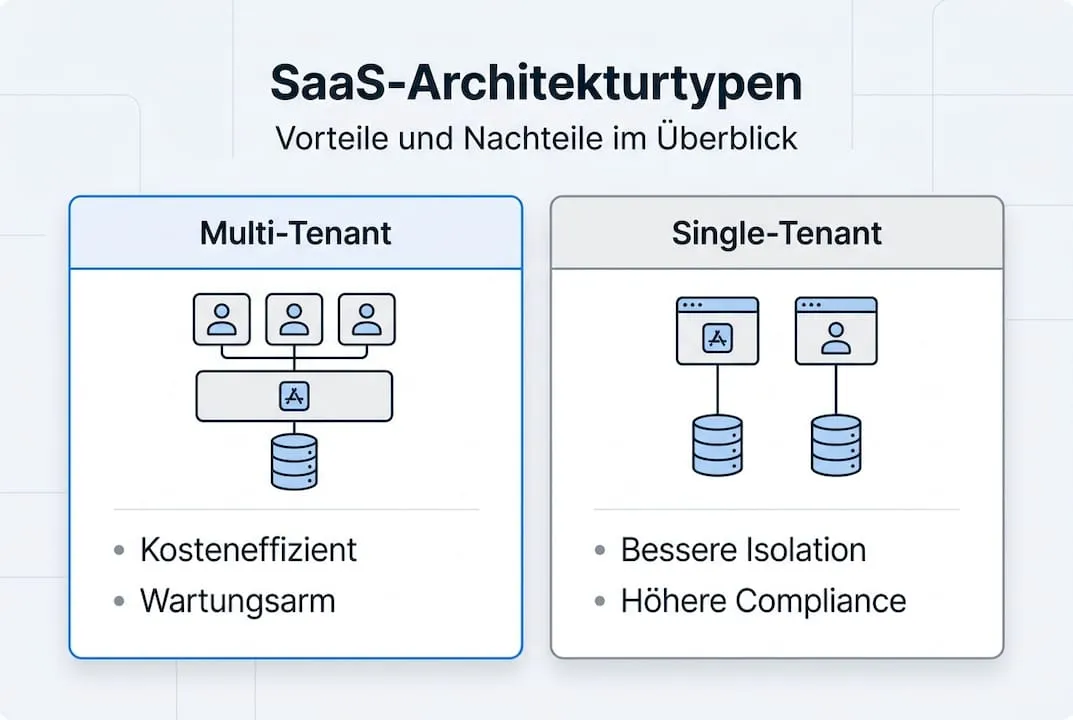
The multi-tenant architecture, where multiple customers (tenants) share the same instance with logical data isolation via a tenant ID, is today the standard for cost-efficient SaaS platforms. It allows resources such as databases, compute and networking to be shared without customer data ever mixing.
Typical B2B SaaS categories that use this model include:
- CRM platforms (sales and customer management)
- Analytics tools (reporting, business intelligence, dashboards)
- Automation platforms (workflow engines, integration layers)
- Legal-tech and FinTech solutions (document management, compliance monitoring)
- HR and recruiting software (applicant management, onboarding)
For founders structuring their engineering services for SaaS, the choice of tenant strategy is not a purely technical decision. It influences pricing, compliance overhead, and the ability to land enterprise customers. A startup that plans for multi-tenant only will hit the wall the moment their first major client shows up with strict data-protection requirements.
A look across our industry pages shows that in regulated sectors such as FinTech or legal-tech, customers frequently demand dedicated environments — or at least demonstrable data isolation at the database level. The architecture has to support that requirement from day one, not as a retrofit.
For architecture thinking at the early stage the rule is simple: treat tenant isolation as an afterthought and you'll pay for it later in expensive rewrites.
Multi-tenant architecture and edge cases: scaling systems, risks, and compliance
Multi-tenant systems offer significant advantages around infrastructure cost and operational overhead. They also bring specific risks that founders and CTOs must understand before settling on an architecture.
The best-known risk is the so-called Noisy Neighbor: a tenant who consumes a disproportionate share of resources and degrades performance for everyone else on the same infrastructure. The problem shows up most often with poorly configured databases or insufficient rate-limiting. The mitigation is consistent resource throttling, per-tenant quota management, and a clear separation of compute resources for critical workloads.
"Many tenants, one system: multi-tenant architecture demands not only technical isolation but also operational processes for monitoring, incident response, and per-tenant compliance evidence."
The critical edge cases include: Noisy Neighbor (resource contention in multi-tenant), cross-tenant data leakage, sharding hotspots, and compliance issues with third-country data flows — for example when data crosses through US cloud services even though EU customers expect GDPR-oriented handling.
What GDPR actually requires (and what it doesn't)
For the DACH market, GDPR is a baseline architecture input — but it pays to be precise, because overstating the law leads to wrong build decisions and, in your own marketing, to claims you can't defend.
- Cross-border transfers, not blanket localisation. Contrary to a widespread myth, the GDPR does not require that all personal data be stored inside the EU. It restricts the transfer of personal data outside the EEA: such transfers are lawful only via an adequacy decision, Standard Contractual Clauses (SCCs), or Binding Corporate Rules, and — where no adequacy exists — a documented Transfer Impact Assessment (Chapter V GDPR). The EU–US Data Privacy Framework permits transfers to certified US providers, but it remains under legal challenge, so prudent teams keep SCCs as a fallback. Sector rules can go further: certain health data (under the European Health Data Space), financial services (DORA), and telecom retention data carry de-facto or explicit localisation obligations.
- EU hosting as a risk and sales decision. Because every third-country transfer adds assessment, documentation, and litigation risk, EU hosting — ideally Germany or Austria — is usually the path of least resistance for DACH B2B and a concrete sales argument with regulated buyers. Treat it as an architectural default, not a legal absolute.
- Data-flow documentation (Art. 30). Every processing activity and transfer belongs in your Record of Processing Activities, with the legal basis and storage location named.
- Tenant data isolation. Logical separation via tenant ID is the minimum; enterprise and regulated buyers often require dedicated schemas or physical separation with provable audit trails.
- Deletion procedures. GDPR Article 17 requires provable erasure on request — genuinely hard in multi-tenant systems, and something you design in, not bolt on.
"GDPR-ready hosting" alone never makes a system compliant: it has to be paired with contracts (DPAs), data-flow documentation, and tooling for data-subject rights.
Pro tip: hybrid architectures — where standard customers run on a shared multi-tenant footprint and enterprise customers get dedicated namespaces or database schemas — combine cost efficiency with compliance flexibility. This pattern is especially worth considering for scalable software architecture in a DACH context.
Building EU hosting and data protection into the architecture from day one materially reduces legal exposure and at the same time becomes a sales argument with enterprise customers. For engineering perspectives on hybrid models, real implementation examples from the DACH market are worth a closer look.
For a deeper dive into multi-tenancy for startups, it is worth reading practical case studies that show how teams achieve isolation, performance, and compliance simultaneously.
Product development and scaling: methods, frameworks, and best practices
Fast product development in a SaaS context demands more than agile sprints. It needs a technical foundation that accelerates releases without compromising stability. The following methods have proven themselves in practice:
- CI/CD (Continuous Integration / Continuous Delivery): Automated build, test and deployment pipelines remove the manual overhead from releases. Teams can ship multiple times per day without manual approval gates.
- Feature flags: New functionality is enabled in code but only activated for selected tenants or user groups. That enables controlled rollouts, A/B testing, and instant rollback without redeployment.
- Control plane for tenant onboarding: A dedicated control surface manages provisioning of new tenants, configuration changes, and resource allocation. It cleanly separates operational logic from product logic.
- API-first design: Every feature is defined as an API first, before UI or integrations are built. That makes future extensions, partner integrations, and white-labelling far easier.
- MLOps for AI features: Anyone integrating AI features needs pipelines for model training, deployment and monitoring. MLOps keeps models production-stable and aligned with data-protection requirements.
The methodologies for fast development cover CI/CD, feature flags, control planes for tenant onboarding, MLOps for AI integration, and composable architectures — all foundational to modern SaaS platforms.
Especially relevant for growing teams is the concept of observability: logging, tracing and metrics need to be captured per tenant, granularly, from the start. That is the only way to isolate performance problems, prove SLA breaches, and pass compliance audits.
Pro tip: composable architectures — where functional blocks are built as interchangeable modules — enable continuous delivery in SaaS without every change destabilising the whole system. The pattern is especially valuable for teams that need to react quickly to customer feedback.
For SaaS project planning the rule is: if you don't bake CI/CD and feature flags in from sprint one, you'll pay later with long freeze phases and manual deployments. The cost of retrofitting is, in our experience, three to five times higher than the cost of doing it from the start.
In the data-engineering for SaaS area, analytics pipelines that process and aggregate tenant data in isolation are another critical building block. Dashboards and reporting features are decisive purchase criteria for many B2B customers.
For anyone who wants to understand scalability in practice, that resource explains horizontal and vertical scaling in a way that translates directly to SaaS architectures. For engineering for startups and the web-development & growth blog you'll find further resources on modern stack decisions.
Success factors and business models: monetisation, pricing, and contracts
Technical excellence alone doesn't secure a sustainable SaaS business. Picking the right pricing model and structuring contracts around GDPR requirements is just as decisive as the architecture itself.
| Pricing model | Description | NRR potential | Good fit |
|---|---|---|---|
| Seat-based | Price per user | Medium | SMB, simple tools |
| Usage-based | Price by consumption | High | APIs, data products |
| Flat-rate | Fixed monthly price | Low | Simple products |
| Tier-based | Feature packages | Medium to high | Enterprise SaaS |
Empirical benchmarks from sources like OpenView, Bessemer and KeyBanc put best-in-class B2B SaaS at net revenue retention (NRR) above 120% — top product-led companies reach 130%+ — with LTV:CAC above 3:1. These are top-quartile figures, not medians: median private SaaS NRR has recently sat closer to 104–106%, and CAC payback has lengthened. A "zero to €1m ARR in 18 months" trajectory is achievable, but it describes a strong outlier, not a plan you can assume.
Usage-based pricing tends to produce the highest NRR because revenue scales with customer value without a sales touch — which is why adoption has climbed sharply. It also lowers the barrier to entry, since new customers don't have to commit to high fixed costs upfront.
"Net revenue retention above 120% means existing customers pay more next year than this year — without a single new customer being acquired. That's the strongest growth engine in SaaS."
For contract design, the EU Data Act (Regulation 2023/2854) matters. It has been in force since 11 January 2024 and applicable since 12 September 2025, governs non-personal data, and applies in parallel to the GDPR. It also reaches non-EU providers that serve EU customers. The most relevant part for SaaS is Chapter VI (Art. 23–31) on switching between data processing services:
- Provider switching & exit support. Customers can switch providers; you must support their exit, provide data in a structured, commonly used, machine-readable format, and observe a maximum two-month notice period plus a transition window.
- Interoperability. Open interfaces and compatibility with the relevant specifications, so data — and, for IaaS, functional equivalence — can be achieved with the new provider.
- Switching fees. To be phased out, with full removal targeted for January 2027.
- Fair contract terms (Chapter IV). Protection, especially for SMEs, against unilaterally imposed unfair terms.
(Subprocessor transparency — naming and approving every third party that processes personal data — is a GDPR Article 28 obligation rather than a Data Act one, but it belongs on the same contract-review checklist.)
For compliance and contract design under the EU Data Act, an early review of existing contract templates is worthwhile — standard wording often falls short.
Practical tips for implementing the new contractual standards:
- Data-protection impact assessments (DPIA) for every processing activity that touches sensitive data.
- Data-processing agreements (DPA) with every subprocessor — kept up to date.
- SLA definitions clearly written, including availability targets or contractually defined guarantees and incident-response times.
- Exit clauses standardised so customers can expect a smooth data transfer when they leave.
- Price-adjustment clauses transparent — especially for usage-based models with variable cost.
H-Studio's German delivery model accounts for these requirements from the start: German or EU hosting options, GDPR-oriented contract structures, and audit-oriented architecture are not treated as afterthoughts.
From real projects: tenant, billing and procurement edges
Architecture decisions look clean on slides. They look different when an enterprise procurement team is in the room. Three patterns we keep seeing:
Hybrid model that saved a FinTech deal. A platform we worked with had a Pool model in production — shared Postgres, RLS for tenant isolation. Their first enterprise prospect was a regulated FinTech that required physical separation as a non-negotiable. Pure rewrite would have been three months. We added a Bridge variant on top of the existing Pool: dedicated database schema per "premium" tenant, same application code, control plane provisioning. Three weeks. The deal closed. Lesson: hybrid is not a compromise — it's a strategic optionality reserve. Build the seams in early.
Usage-based pricing flip and what it cost technically. In one engagement we observed a client switch from seat-based to usage-based pricing mid-2025. The commercial impact was significant — net revenue retention moved from below 100 % to comfortably above the 120 % usage-based benchmark — but the technical work was six weeks of metering pipeline (per-tenant event aggregation, billing-platform integration, monthly reconciliation), then four weeks of stabilizing the read model under the new query patterns. Billing changes are not a marketing tweak. They're a CQRS-shaped engineering project. Plan three months, not three weeks.
Subprocessor list that lost a deal. A SaaS won a public-sector evaluation on features and price, then lost it during legal review. Reason: more than half of the subprocessors on their list were US-based standard tooling (error tracking, product analytics, customer messaging, marketing automation) with no documented EU-hosted alternative. The procurement note was clinical: "vendor cannot demonstrate EU-only data path." Subprocessor mapping in DACH B2B is part of architecture, not an afterthought for the legal page — and an EU-hosted equivalent has to be lined up before the tender is filed, not after.
Control plane at 80 tenants. A team without a control plane spent two engineer-days per week on manual tenant lifecycle (provisioning, schema migrations on per-tenant DBs, role changes, billing-tag updates) once they crossed 80 tenants. We built a minimal control plane in two weeks: REST API, migrations runner, per-tenant quotas, exec dashboard. Onboarding fell to 8 minutes per tenant, automated. The control plane isn't infrastructure overhead — it's a growth multiplier. It pays back within the first quarter you have it.
For the lifecycle and operations side of these problems, see our companion piece on building production-ready SaaS — that one focuses on CI/CD, secrets, observability and incident response. This article stays on tenant patterns, billing and the contracts side.
Our expert perspective: scaling SaaS the right way in the DACH B2B market
The classical multi-tenant strategy is often presented in architecture discussions as a universal solution. In real-world practice with DACH companies the picture is more nuanced. Mid-market customers in finance or healthcare often don't accept logical data isolation as sufficient. They require physical separation — or at minimum, dedicated database schemas with provable audit trails.
Hybrid models aren't a compromise — they're a strategic decision. Architecting for scale with a hybrid plan from day one means standard customers run cost-efficiently on a shared environment and enterprise customers get dedicated resources, all without maintaining two separate codebases.
Compliance as a competitive advantage is not a cliché. Startups that proactively communicate EU hosting, GDPR readiness, and Data-Act readiness can move enterprise deals forward faster because they reduce procurement friction. The blunt SaaS perspective: treat compliance as a technical chore and you miss a sales lever.
The concrete expert recommendation is this: don't treat EU hosting and contract design as a closing topic. Build them into the architecture sprint. Every architectural decision that later requires a compliance retrofit costs three to five times more in development time.
Scalable SaaS solutions and architecture consulting for founders
For B2B SaaS founders and CTOs who want to address the challenges in this article in a structured way, H-Studio offers direct support — from initial architecture consulting through to a production-ready platform.
Engineering services for SaaS cover Architecture Sprints before the MVP launch, scalable backend architectures with Java/Spring Boot and Node.js, and data-protection-aware infrastructure with EU hosting, DPA setup and cleanly documented data flows. For teams modernising their web stack or building data engineering for SaaS, experienced senior engineers are available as long-term partners. Get in touch and reduce the risk of a rewrite trap after month 12.
Frequently asked questions about SaaS
What benefits does multi-tenant SaaS bring for startups?
Multi-tenant SaaS enables cost-efficient scaling because multiple customers share the same instance with logical data isolation via a tenant ID. That reduces infrastructure cost considerably and accelerates updates, since only one codebase has to be maintained.
What are the typical edge cases in SaaS architectures?
Common edge cases include Noisy Neighbor, cross-tenant data leakage, and compliance problems with international data flows. Those risks are minimised by consistent resource throttling, strict tenant isolation, and a documented, lawful approach to any transfer of personal data outside the EEA.
How can fast product development work in SaaS?
Using CI/CD, feature flags and a control plane accelerates releases and enables controlled rollout of new functionality. MLOps and composable architectures round out the stack for AI-powered SaaS products.
Does GDPR require EU hosting for B2B SaaS?
No — GDPR does not mandate EU-only storage. It restricts transfers of personal data outside the EEA, which are lawful via an adequacy decision, SCCs or BCRs plus, where needed, a Transfer Impact Assessment. EU hosting is nonetheless often the simplest way to reduce that risk and a practical advantage in DACH enterprise sales, where regulated customers review these questions early. Hosting alone doesn't make a system compliant — it has to be paired with proper contracts, data-flow documentation, and data-subject-rights tooling.
Read more
This article maps the broad ground for B2B SaaS founders. For deeper, more specific tracks:
- Startup MVP Builds — production-ready foundation for the first 100 paying users (the topic this article introduces)
- Architecture Sprint · 5 days, €3,500 — fixed-scope architecture review before any code
- Scalable Backend Systems for SaaS Growth — backend-specific deep dive
- Building Production-Ready SaaS — launch-readiness checklist
Drafting assisted by BabyLoveGrowth. Edited and fact-checked by Anna Hartung.